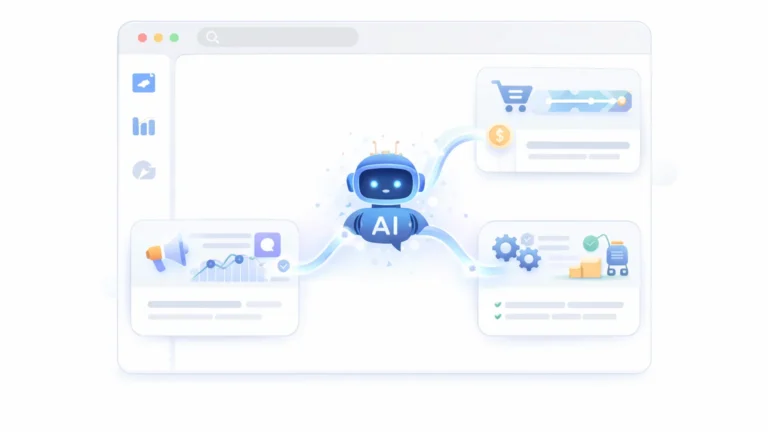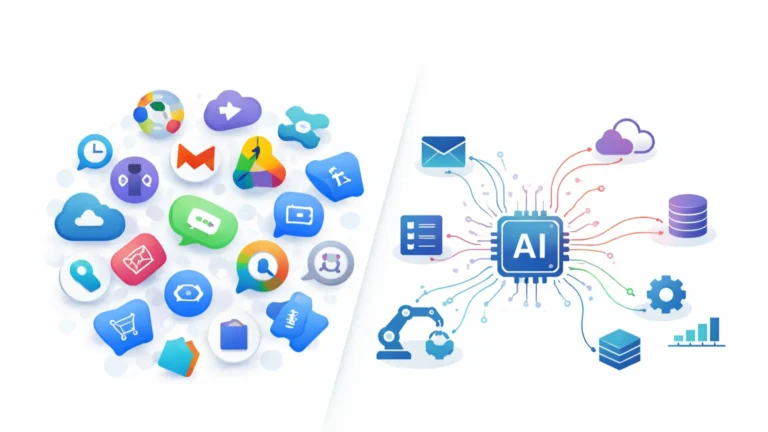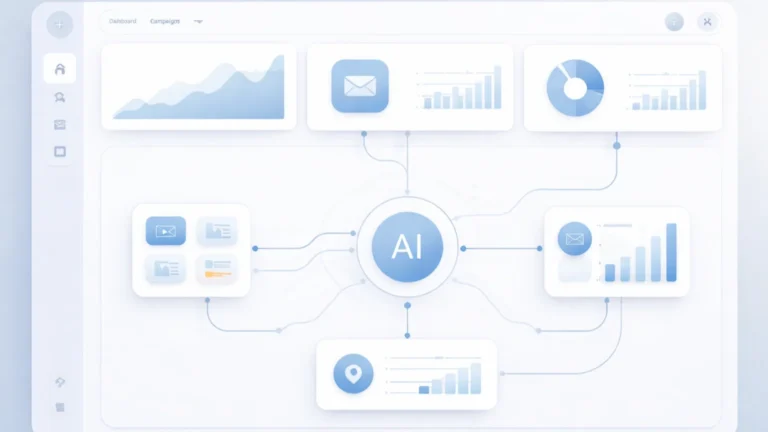

AI tools for small businesses can automate daily operations, reduce costs, and help you grow faster—without hiring more employees. In 2026, smart businesses are no longer doing everything manually—they’re building AI-powered systems.
Most small business owners struggle with the same challenges.
Limited time. Limited budget. Too many repetitive tasks.
Marketing, customer support, content creation, and operations all compete for attention.
It slows growth.
AI changes that.
With the right tools, you can automate customer support, generate marketing content, analyze data, and streamline operations—saving hours every week.
This isn’t about replacing your team—it’s about increasing efficiency and output.
In this updated guide, you’ll discover the best AI tools for small businesses in 2026—organized by real use cases like marketing, customer support, content creation, and automation—plus how to combine them into a powerful business system.
What Are AI Tools for Small Business?
AI tools for small businesses are software applications powered by artificial intelligence that help automate daily operations, improve decision-making, and increase efficiency across areas like marketing, customer support, content creation, and analytics.
Instead of managing everything manually, business owners can use AI to streamline workflows and focus on growth.
What AI Tools Actually Do
Modern AI tools support different parts of business operations:
- Marketing: Generate content, ads, and campaigns
- Customer support: Automate responses with chatbots
- Content creation: Write emails, blogs, and social posts
- Operations: Automate repetitive tasks and workflows
- Analytics: Provide insights for better decisions
Each tool focuses on a specific function—but together, they create a complete business system.
Examples of Popular AI Tools
- ChatGPT → content, communication, and automation
- Tidio → AI chatbot for customer support
- Surfer SEO → SEO optimization and content strategy
- Canva AI → design and marketing visuals
These tools don’t replace business owners—they remove repetitive work and improve efficiency.
The Real Advantage
The biggest benefit of AI tools for small businesses is leverage.
- Save time on daily tasks
- Reduce operational costs
- Improve customer experience
- Scale without hiring more staff
This allows small businesses to compete with larger companies more effectively.
Why Small Businesses Are Using AI
Small businesses are adopting AI not because it’s a trend—but because it solves real problems: limited time, limited budget, and the need to grow faster.
AI is changing how businesses operate.
Reducing Costs Without Hiring More Staff
Hiring employees is expensive.
- Salaries
- Training
- Management
AI tools can automate many tasks:
- Customer support
- Content creation
- Marketing campaigns
Result: Lower operational costs with the same (or better) output.
—
Saving Time on Repetitive Tasks
Many business tasks are repetitive:
- Responding to customers
- Writing emails
- Managing content
AI handles these tasks quickly.
Result: More time to focus on strategy and growth.
—
Improving Customer Experience
Customers expect fast responses and personalized experiences.
- Instant replies
- Relevant recommendations
- Consistent communication
AI chatbots and automation tools make this possible.
Result: Higher customer satisfaction and retention.
—
Competing With Larger Businesses
Large companies have more resources.
AI helps level the playing field:
- Automate marketing
- Use data-driven insights
- Scale operations efficiently
Result: Small businesses can compete more effectively.
—
Making Better Decisions With Data
AI tools analyze data faster than humans.
- Customer behavior
- Sales trends
- Campaign performance
This leads to smarter decisions.
Result: Better strategies and improved outcomes.
—
The Real Shift: Business Leverage
AI gives small businesses leverage.
- Do more with fewer resources
- Scale faster without large teams
- Increase efficiency across operations
Businesses that adopt AI early gain a significant competitive advantage.
10 Best AI Tools for Small Business (By Use Case)
Not all AI tools serve the same purpose. The best tools are designed for specific parts of your business—marketing, customer support, content creation, operations, and analytics.
1. ChatGPT – AI Assistant for Daily Business Tasks
Best for: Content, communication, and automation
ChatGPT helps small businesses write emails, create marketing content, answer customer questions, and generate ideas.
Why it stands out: Versatile tool for multiple business tasks.
—
2. Tidio – AI Chatbot for Customer Support
Best for: Customer service and lead capture
Tidio provides AI-powered chatbots that respond instantly to customer inquiries.
Why it stands out: 24/7 support without hiring staff.
—
3. Jasper AI – Marketing Content Creation
Best for: Ads, blog posts, and sales copy
Jasper helps businesses generate high-converting marketing content quickly.
Why it stands out: Optimized for conversions and marketing.
—
4. Canva AI – Design & Branding
Best for: Social media, ads, and branding visuals
Canva AI allows businesses to create professional designs without designers.
Why it stands out: Simple, fast, and beginner-friendly.
—
5. Surfer SEO – SEO & Content Optimization
Best for: Ranking content on Google
Surfer SEO analyzes competitors and helps optimize content for better rankings.
Why it stands out: Data-driven SEO insights.
—
6. Pictory – AI Video Marketing
Best for: Creating marketing videos
Pictory turns scripts or blog content into engaging videos automatically.
Why it stands out: No video editing skills required.
—
7. Zoho Zia – AI Business Intelligence
Best for: CRM, analytics, and forecasting
Zoho Zia provides insights into sales, customer behavior, and business performance.
Why it stands out: Deep integration with business operations.
—
8. Grammarly Business – Communication & Writing
Best for: Emails and professional communication
Grammarly ensures clear, professional communication across teams and customer interactions.
Why it stands out: Improves brand consistency.
—
9. Zapier – Workflow Automation
Best for: Connecting apps and automating tasks
Zapier automates repetitive workflows by connecting different business tools.
Why it stands out: Thousands of integrations.
—
10. Notion AI – Productivity & Knowledge Management
Best for: Team productivity and organization
Notion AI helps businesses manage tasks, documents, and workflows efficiently.
Why it stands out: Combines productivity with AI assistance.
—
Pro tip: You don’t need all these tools. Start with 2–4 tools based on your business needs—marketing, support, or automation—and expand from there.
Best AI Business Workflow (System)
Using individual AI tools can improve your business—but combining them into a structured system is what truly drives growth.
The most successful small businesses don’t just use tools. They build AI-powered business systems.
Minimal Business Stack (Best for Beginners)
- ChatGPT → content, emails, and ideas
- Canva AI → design and visuals
This simple setup is enough to start automating basic tasks.
—
Marketing & Growth Stack
- Jasper AI → marketing content and ads
- Canva AI → visuals and branding
- Surfer SEO → content optimization
- Pictory → video marketing
This stack helps attract traffic and generate leads consistently.
—
Customer Support & Sales Stack
- Tidio → AI chatbot for customer support
- ChatGPT → automated responses and communication
- Zoho Zia → CRM insights and sales tracking
This setup improves customer experience and increases conversions.
—
Automation & Productivity Stack
- Zapier → automate workflows
- Notion AI → organize tasks and knowledge
- Grammarly Business → improve communication
This stack reduces manual work and increases efficiency.
—
Example Business Workflow (Real Use Case)
Here’s how an AI-powered business workflow looks:
- Use Jasper / ChatGPT → create marketing content
- Use Canva AI → design visuals
- Use Surfer SEO → optimize content
- Use Pictory → create video content
- Use Tidio → handle customer inquiries
- Use Zapier → automate workflows
This transforms your business from manual operations into an automated system.
—
Keep Your System Simple
The biggest mistake small businesses make is overcomplicating their setup.
- Too many tools = confusion
- Too many subscriptions = higher costs
Start with 2–3 tools, build a simple workflow, and expand as your business grows.
A simple system that runs smoothly will always outperform a complex one.
How AI Improves ROI for Small Businesses
The biggest reason small businesses adopt AI tools isn’t convenience—it’s return on investment (ROI).
AI doesn’t just automate tasks. It reduces costs, increases efficiency, and helps generate more revenue.
Reducing Operational Costs
Running a business requires multiple roles:
- Customer support
- Content creation
- Marketing management
AI tools can handle many of these tasks:
- Chatbots → customer support
- AI writing tools → content creation
- Automation tools → repetitive workflows
Result: Lower expenses without reducing output.
—
Saving Time (Hidden ROI)
Time is one of the most valuable resources for small businesses.
- Manual tasks slow growth
- Repetitive work wastes time
AI speeds up execution:
- Generate content in minutes
- Automate daily tasks
- Reduce manual effort
Result: More time for strategy, sales, and growth.
—
Increasing Marketing Performance
AI improves how marketing campaigns perform:
- Better content → more engagement
- SEO optimization → more traffic
- Automation → consistent campaigns
Result: Higher conversions and revenue.
—
Improving Customer Experience
Customer experience directly impacts revenue.
- Faster responses
- Personalized communication
- 24/7 support
AI tools like chatbots and automation improve customer satisfaction.
Result: Higher retention and repeat sales.
—
Scaling Without Increasing Costs
Traditional growth requires more staff and resources.
AI changes that.
- Handle more customers
- Run more campaigns
- Produce more content
All without proportional cost increases.
Result: Higher profit margins as your business grows.
—
The ROI Formula
AI improves ROI by increasing output, reducing costs, and optimizing performance at the same time.
For small businesses, this means faster growth with fewer resources.
How to Choose the Right AI Tools for Your Business
With so many AI tools available, the real challenge isn’t finding tools—it’s choosing the right ones for your specific business needs.
The best approach is simple: focus on your goals, workflow, and bottlenecks.
Start With Your Business Goal
Different businesses prioritize different outcomes:
- Increase traffic → Surfer SEO, Jasper AI
- Improve customer support → Tidio, ChatGPT
- Boost branding → Canva AI
- Automate operations → Zapier, Notion AI
Choose tools based on what you want to achieve first.
—
Identify Your Biggest Bottleneck
Ask yourself: what is slowing your business down?
- Content creation → AI writing tools
- Customer support → chatbots
- Marketing → automation tools
- Operations → workflow automation
Fix your biggest bottleneck first for maximum ROI.
—
Consider Your Business Size
Your needs will depend on your stage:
- Solopreneurs: ChatGPT, Canva AI
- Startups: Jasper AI, Tidio
- Growing teams: Zoho Zia, Zapier
Choose tools that match your scale and complexity.
—
Check Integration Capabilities
AI tools are more powerful when they work together.
- Marketing + CRM + automation
- Content + SEO + analytics
Tools like Zapier help connect everything into one system.
—
Free vs Paid Tools
Not every business needs paid tools immediately.
- Free tools → good for testing and starting
- Paid tools → better for scaling and automation
Upgrade when your business needs more efficiency and performance.
—
Focus on Simplicity
Many businesses make the mistake of using too many tools.
- Too many tools = complexity
- Too many features = confusion
The best system is simple, efficient, and easy to manage.
—
Test Before You Commit
Most AI tools offer free trials or entry-level plans.
- Test multiple tools
- Compare results
- Choose what works best
Don’t rely on popularity—focus on real performance.
—
Bottom line: The right AI tools are not the most advanced—they’re the ones that solve your biggest problems and help your business grow efficiently.
Common Mistakes Small Businesses Make with AI Tools
AI tools can significantly improve business efficiency—but using them incorrectly can lead to wasted time, unnecessary costs, and poor results.
Many small businesses make the same mistakes when adopting AI.
Avoiding these will help you get better results faster.
1. Using AI Without a Clear Strategy
Many businesses start using AI tools without defining goals.
- No clear objectives
- Random use of tools
- Inconsistent results
This issue is hinted in your original article 0, but becomes more critical as AI adoption grows.
Fix: Define clear goals (traffic, leads, sales) before using AI tools.
—
2. Using Too Many Tools at Once
More tools don’t mean better results.
- Complex workflows
- Higher subscription costs
- Reduced efficiency
Fix: Start with 2–3 tools and build a simple system.
—
3. Ignoring ROI and Costs
Some businesses adopt AI tools without tracking results.
- No cost vs benefit analysis
- Unused subscriptions
Fix: Measure time saved, cost reduced, and revenue generated.
—
4. Over-Automating Everything
Automation is powerful—but too much automation can harm customer experience.
- Generic responses
- Impersonal communication
Fix: Combine AI automation with human interaction where needed.
—
5. Not Training or Optimizing AI Tools
AI tools require input and refinement.
- Poor prompts
- No optimization
Fix: Improve prompts, test outputs, and refine workflows.
—
6. Ignoring Customer Experience
AI should improve—not reduce—the quality of customer interactions.
- Slow or irrelevant responses
- Confusing user journeys
Fix: Focus on delivering value and clarity.
—
7. Not Building a Business System
Using tools without a structured workflow leads to inefficiency.
- Disconnected tools
- Repeated manual work
Fix: Build a system:
- Attract → Convert → Automate → Retain
This is where AI creates real business impact.
—
Bottom line: AI tools are powerful—but the businesses that succeed are those that combine automation with strategy, data, and a clear system.
FAQ: AI Tools for Small Business
What are the best AI tools for small businesses?
The best AI tools include ChatGPT for content and automation, Tidio for customer support, Canva AI for design, Surfer SEO for SEO, and Zapier for workflow automation.
Are AI tools expensive for small businesses?
No. Many AI tools offer free or affordable plans, making them accessible even for startups and small teams.
Can AI help small businesses grow?
Yes. AI tools help automate tasks, improve marketing performance, enhance customer experience, and increase overall efficiency.
Which AI tool should a small business start with?
ChatGPT and Canva AI are great starting points because they are easy to use and provide immediate value.
Do I need technical skills to use AI tools?
No. Most modern AI tools are user-friendly and require little to no technical knowledge.